

There for You
No one loves you like your teenage soulmate. It's not what you say, it's how deeply you feel.

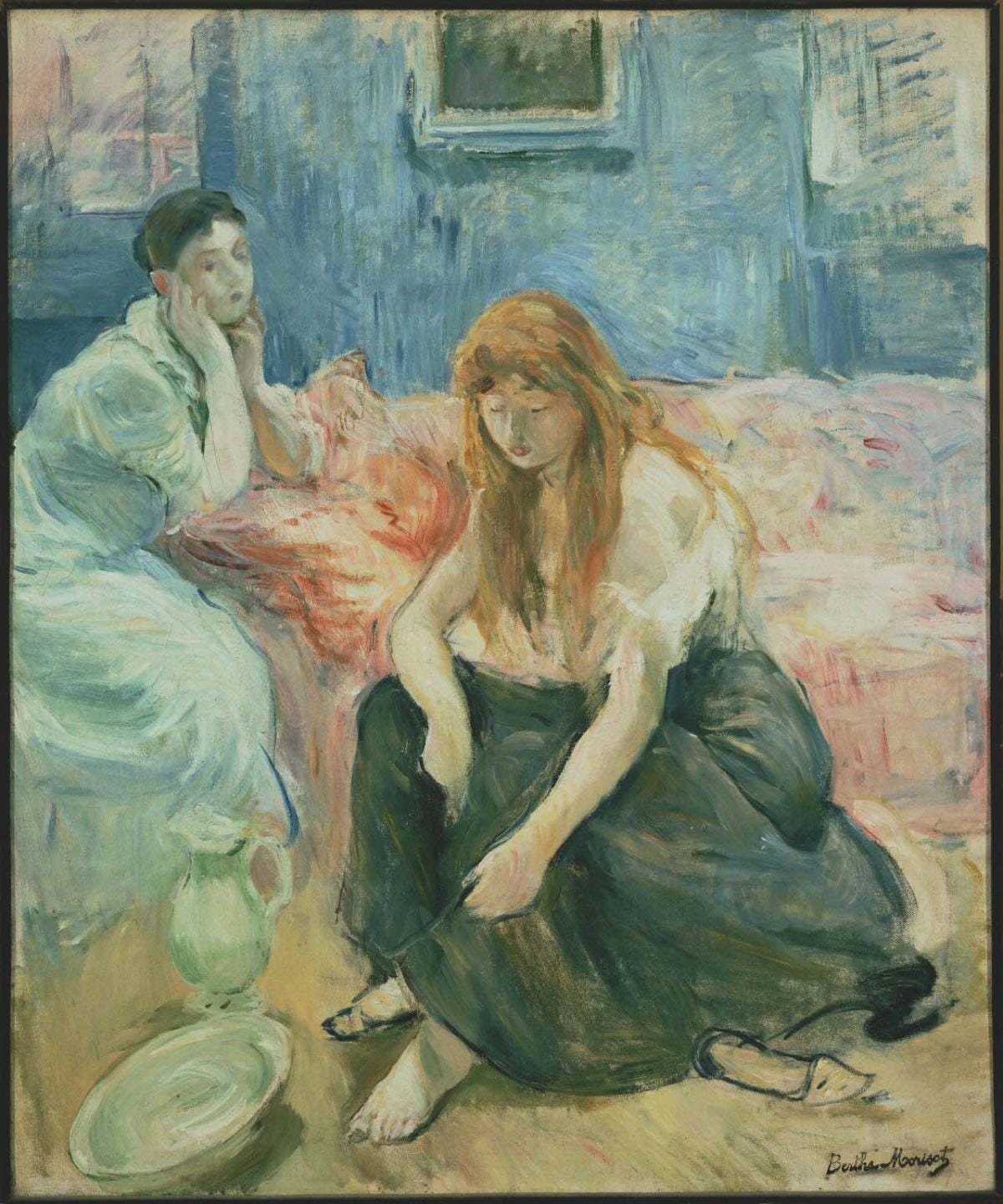
When I was 16 and had never been kissed, my best friend told me how an orgasm felt. Like running your heart out till the ground vanished, the sky opened up and into the air you flew. Shakespeare called it “dying.” Anne had two cravings, poetry and sex. She read as if she lived on metaphor and rhythm. Rolled in and out of beds and back seats with boys she loved madly for a while or was giving a whirl just because. She thrilled, awed and alarmed me like no one else I knew.
Anne was that girl boys call “easy” and mothers call “a bad influence.” My mother said, under her breath, that every visit from Anne made her want to scrub the toilet. She would shudder when my friend tore out of our driveway, tires squealing, with me in the death seat. Yet it was my mother who had found Anne for me, plucked her from the creative writing class she taught in a town a few miles down the road. Something about this girl captivated her—wit, curiosity, the way Anne flipped a word on its head to make it new. My writing won national contests, but I had no writer friend. Anne must come to dinner. By the time my mother rued the day, every call from Anne was a summons to our private world.
I’d race for my father’s extension phone, close his study door and sink into Anneland. There we swooned and sighed until one parent or another yelled that more than hour should be plenty long enough and they had to call the plumber. For a few more precious minutes, I twisted the cord around my fingers as we spoke our language of connection. “Adam:” the guitar-strumming, Yeats-quoting lover of our imaginations. “Outs:” loners like us who chose coffee houses over pep rallies and Joan Baez over the Beatles. “H.S.:” short for Harvard Square, epicenter of all things out, where the newsstand sold Film Quarterly, Adams whizzed around on motor scooters and we splurged on matching rawhide sandals that tied around the ankles.
We would take the musty-smelling bus from New Hampshire to traipse around Harvard Square, pretend-Radcliffe students in sandals that would not stay tied. Sometimes we went barefoot over stones and cigarette butts, exulting in our goofball freedom. We’d pause in front of Club 47, where Baez got her start, and imagine watching her eyes fill with sadness for Mary Hamilton—knocked up by the king, hanged for killing the baby. In the Baez ballads that obsessed us, women meet terrible ends just for being born female and powerless. Anonymous was a woman. We knew.


None of my dramas compared to Anne’s. I pined for love, she kept losing it. I murmured my sorrows, she proclaimed hers at full voice. Her moods were an ocean— glitter and ripple one day, hundred-foot waves the next. I would sigh into the receiver, “Oh, oh… no, no…” My mother, listening in at the study door, thought Anne was drowning me in anguish.
In fact my friend was throwing me a lifeline. No one else could pull me out of self-pity. She needed a witness; I showed up, trusting she would laugh again tomorrow. How she exulted over Christopher Smart, the 18th-century devotional poet confined to an asylum with only his cat for company. Blinkered men called him mad, but Smart was the one who knew the score. In the cat’s every stretch and purr, he saw the prayer of God’s feline servant. Wasn’t that wild? Anne’s triumphant laughter rang like wind chimes.
My parents taught English literature and raised me in a houseful of books. Anne’s working-class parents weren’t readers. Yet I had never heard of Christopher Smart until she stumbled on him. Everything I took as my due she had to hunt down by herself. She was overweight in the age of Twiggy, tousle-haired when Seventeen magazine decreed the beehive and the gleaming flip. An adopted child whose devoted parents couldn’t heal her sense of abandonment. No one saw her gallantry but me.
I hadn’t heard from Anne in years when she called me at work in Toronto, my home all my adult life. She’d just picked up a copy of Chatelaine and found my photo next to the Editor’s column. The topic was depression: mine. “I hid behind a mask of competence, meeting every deadline… Because I worked at home, no one knew about the days I spent crying.”
Anne still lived in New Hampshire, where Chatelaine was unknown, but she happened to be passing through Toronto as I went public with my history. In 1997 you didn’t hear much about depression. Readers bombarded me with letters. How brave I was, they said. Anne had something more personal to tell me: “If I had known, I would have been there for you.”
Still in her 40s, she already had gravel in her voice. She was teaching high-school English then. Delighted in her students, wrote poems after hours. Still thought of our friendship, but one thing puzzled her—a call I never returned back when we were 20 or so. “You were visiting your mother from Toronto. She said she’d tell you I called. Did you get the message?”
I let my mother take the fall. Anne’s turmoil had worn me out. I didn’t know how to help a friend who never laughed anymore or brushed the lint off her ever-present black turtleneck; who veered between grandiosity and despair. She was going to be a poet and no one could stop her; she was going to be a prostitute for lack of any other talent. Sometimes she didn’t dare pick up the phone: If a man answered with sex on his mind, she wouldn’t be able to say no. Her tailspin scared us both, and in the end I turned my back. Decades later, I didn’t have the courage to admit it. Why open a painful subject?
If you do not drive and haven’t hitchhiked since Bobby McGee flagged a diesel down for Janis Joplin, a trip to Durham, New Hampshire presents a logistical conundrum. My high school was hosting a reunion, and someone would have to drive me here and there. Anne didn’t go to Oyster River High but she met my bus from the airport. All weekend she ferried me around—to get-togethers with schoolmates she never knew; to the beach where my sister was waiting; for ice cream at one of those joints where half the patrons are barefoot and the scarred picnic tables sit on a lawn so lush, kids are doing cartwheels. She wouldn’t let me pay for a thing. As she put it, “I love waking up knowing I’m going to see Rona today.”
Tenderness took me by surprise and held me all weekend. The past had carried off my magazine career and the whole industry as I had known it. People I once considered friends turned out to be faces in boardrooms and ballrooms. Confidantes had died young. Anne was still there for me—diabetic and struggling with congestive heart disease, but laughing again in a lower register.
She had a husband but hardly spoke of him. In a new career as a realtor, she flinched at the misery she saw. One family was evicted in the middle of a toddler’s birthday party, balloons still in place when Anne arrived with a client. Her compassion had deep roots. Her son, a gifted and adored only child, seemed bound for a shining future till a car crash injured his brain and turned him into someone else who would never go to college or support himself. I sat with my friend and listened, still her witness.
She must have asked about the call I never returned. In the second blooming of our friendship, she raised it whenever we spoke, hungry for proof that my long-dead mother was to blame. Telling the truth would force a hard conversation. Damned if I would let an old rupture taint the joyful present.
I was sipping my first cup of coffee when I opened Facebook and learned that Anne had died, not yet 64. A heart attack took her down in a casino. Why not a movie theater? Or her own living room while reading Emily Dickinson? She’s been gone nearly 13 years, but something in me still wants to protect her from the furies that lashed her till the end. Anne gambled the way, in her youth, she jumped into cars with men. The way she ate a batch of granola at one go. She wanted me to know the truth so I could accept her whole self, or so it seems now. When I asked if her losses amounted to a six-figure sum, she didn’t hesitate. Yes.
I’m still looking for the whole Anne. First stop: the tributes on Facebook and Legacy.com. For student after student, Anne kindled the pleasures of language. She wouldn’t take any guff but she could tell when you needed a hug. “A brilliant shot of creative inspiration and support,” said a woman I tracked down on Facebook, who agreed to speak with me about Anne. I had to hear the voice of someone whose life my friend had cracked open.
I always meant to come clean with Anne, and now it’s too late. “You were young,” I imagine her saying. “Life hadn’t tempered you.” What a conversation that would be. I think she’d tell me herself what I recently learned from others. It’s not that she kept secrets, just that she’d built a wall around our reborn friendship.
Anne had been sexually abused, repeatedly, while both her parents worked. At 22 she tried to help a friend who was pregnant, single and terrified of losing her career. The plan went horribly wrong. The friend died in agony, the doctor never practiced again, Anne faced a police investigation. Had abortion been safe and legal, none of this would have happened. Anne died believing those days were over in America. She’d be appalled to know that she was wrong, but that’s a subject for another time. In the spring of 1970, I was not there for Anne. I had already cut her loose.
The dangers Anne endured and the breaks that never came her way set off a mighty roar in my head. I want to roll back time and beat fate off with a spiked club. Any one of my friend’s trials might have crushed a less gallant spirit, but she had the grace to learn early what escaped me until now: When your load feels unbearably heavy, it might help to lighten someone else’s.
Since I can’t speak to Anne, I reached out to the one who knew her best. I met Mary once for about three minutes but her kind face made an impression. On Anne’s Facebook page, hers is the most heartfelt presence. Something told me they were more than friends, and hearing the truth from Mary made me glad for Anne. She never divorced her husband, but for 22 years she had a loving wife. When Mary told me Anne felt treasured by me, I took a long exhale.
I listened to Mary as I had once listened to my friend. She listened back. Our voices reminded me of hands cupped around the candle flame that was Anne. The facts of her life are ashes; the love still dances. Of the glimpses Mary shared of her life with Anne, I’ll hold one close—their singing group for women. The group’s Bible, Rise Up Singing, invites anyone and everyone to sing the familiar songs that turn strangers into friends. “Amazing Grace,” “New York, New York,” “Home on the Range.” On page 13 is “Mary Hamilton.”
Have you reconnected with a friend from your past? Have you ever struggled to come clean with a friend? The floor is yours. I’ll do my best to answer every comment. If I’m a bit slow, chalk it up to the family Christmas party. My bocconcini balls are soaking up olive oil, garlic and herbs as I type.
All my essays are free to read and share. If this one made an impression, you might enjoy “The Things We Carry,” among my most popular posts. And did you know you can search this stack or any other for topics that appeal? Go to my home page, type “friend” into the search bubble, and up come a slew of other stories I’ve told on a theme that won’t let me go.
I’m boundlessly grateful for your shares, likes and comments—each one a sign that my words made a difference to you. That’s what I’m here to do, and you’re the ones who know if I’ve done it. Some readers of heart and means have chosen paid subscriptions, just because they believe in my work. If you are so moved, I’d be honored. No pressure, though. We’re friends either way, and you can’t buy friendship.
My goodness, you do this thing called writing so beautifully, I'm usually left sitting in my chair, mouth agape. That happened today, too, but I am left breathless, as well. Thank you, Rona, for your honesty, and the grace with which you tell your life and the lives of your beloveds. xo
This riveted me, Rona. I had a similar experience. I met a woman in her twenties when I was just thirty years old. The circumstances of our meeting were hilarious when she called my house, and my eldest son pretended to be me and agreed to speak at her women's group. I eventually moved two states away, but we remained close. She went through two divorces and married a narcissist who drove her to drink. That season was hard for me, having been raised in an alcoholic home. I distanced myself, especially emotionally. I dreaded her phone calls. But she still made them. In one call, she told me she was in the hospital. She had a blood clot. She couldn't drink there, so for two weeks we had alcohol free conversations. She went home on a Saturday, and we talked three times. By Sunday morning, she was dead. It was then that I realized she was the best friend I had ever had. I still know that, and I still miss her so, five years later.