

The teapot that started a tempest
It held my happiest memories of my mother. Damned if I would let her second husband keep it.

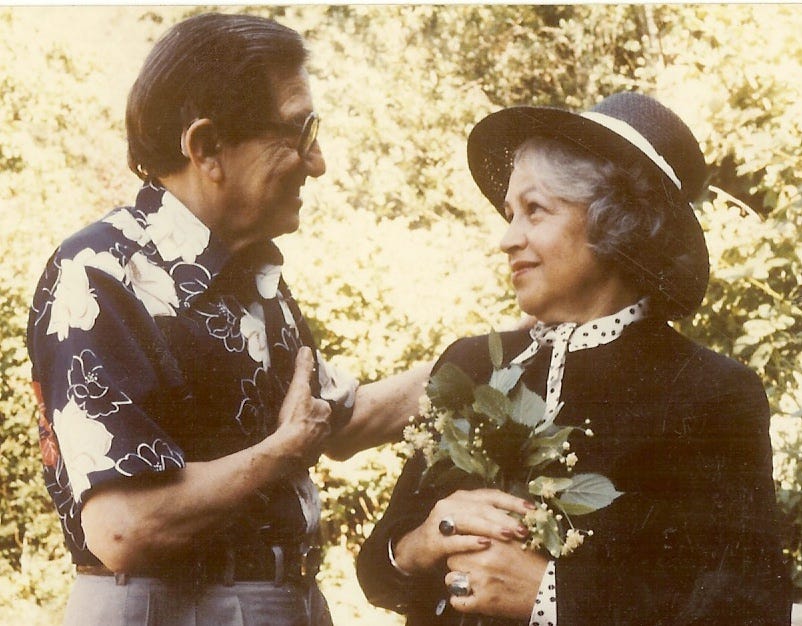
My mother’s second husband must have been around 100 when we met at the bakery where they used to fill their basket together. He fixed me like an insect on the pin of his glare and called me to account on the matter of the teapot.
Sydney did not simply state his case. He boomed it, his British diction crisp as the lapels on his jacket. In the decades since my mother died, he’d grown increasingly deaf and spoke at the room-filling volume he could hear. The Harbord Bakery’s entire clientele turned to marvel at his tirade. He bought that teapot for Fredelle. I had no claim to it. Mean-spirited, that’s what I was.
We’d gone over this before, yet he’d chosen to ignore the facts (either that or lost his marbles). “Sydney, that teapot was a gift from my father way back in the 60s. They drank English tea from that pot every afternoon at 4. Mother wheeled it around on a teak trolley from Denmark…”
He cut me off, shaking his fist. “Mean-spirited!” If Rumpelstiltskin wore a silk tie from the best haberdasher in town, this quivering gnome would be his double. I half-expected fury to break him in two. My mother had adored him, but damned if he was getting her Victorian pewter teapot.

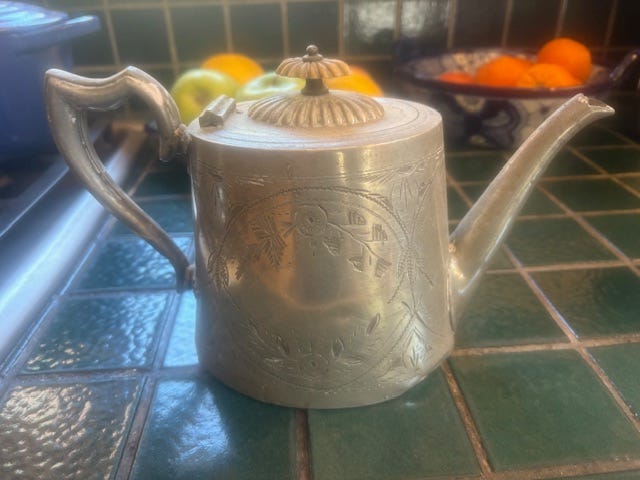
I’d never seen another teapot like my mother’s, engraved with flowers and crowned with an ivory finial. It was not so much a gift from my father as a nudge. The son of British missionaries in the days of the Raj, he hankered for Victorian rituals foreign to my Jewish mother. The tea trolley imbued her decor, which leaned toward bold colors and playfully mismatched furniture, with a touch of the vanished empire.
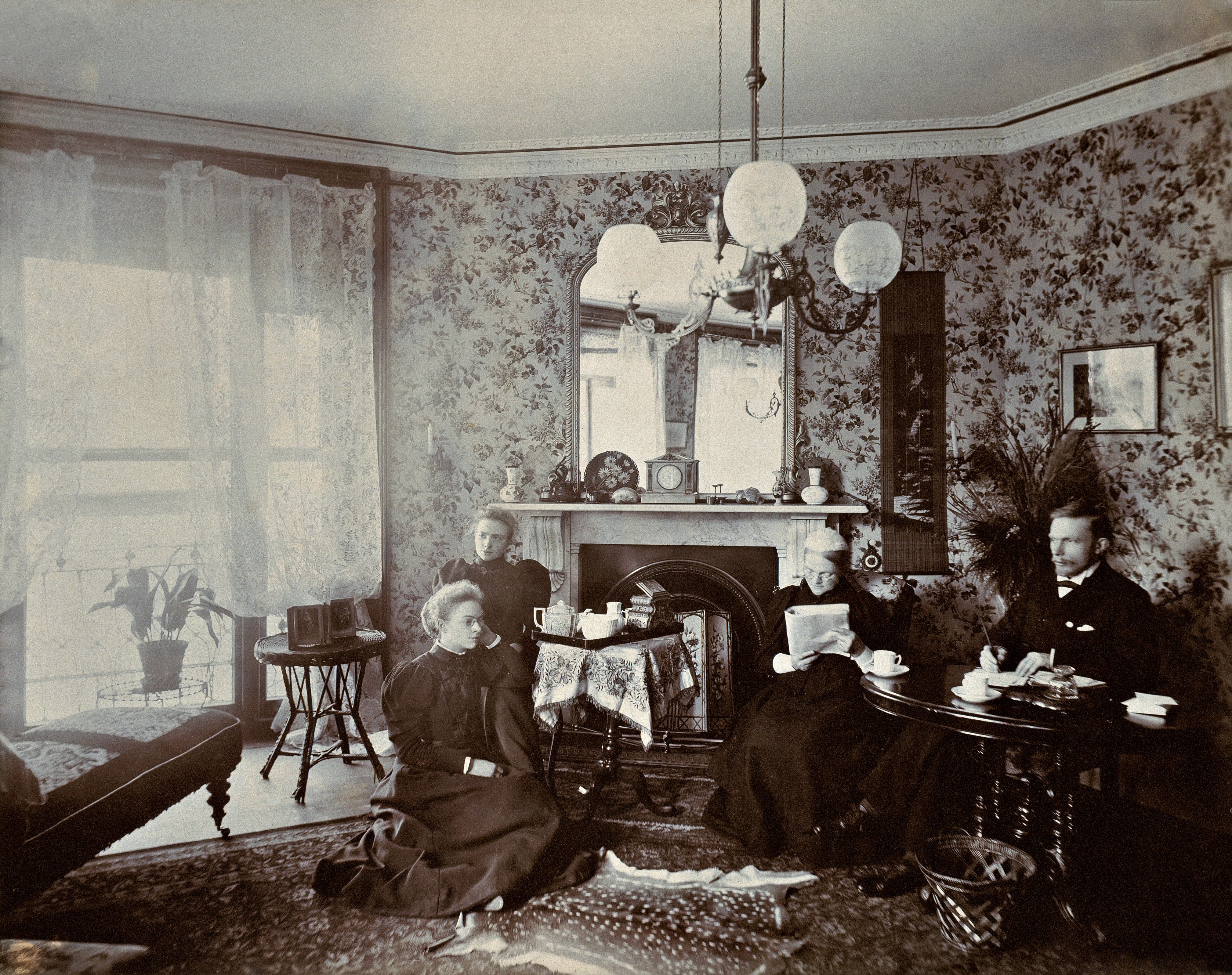
My mother liked strong black coffee and stained every cup with red lipstick. Teatime embodied the wife she could not be, a woman of restraint and circumspection. I never heard her call my father an anti-Semite, but she flinched when the University of New Hampshire, where he taught, asked the two of them to chaperone a dance at a fraternity that excluded Jews. She said she couldn’t do it; he insisted they had an obligation. He hoped she wouldn’t wear a “flagrant” dress.
When she sent him packing in midlife, she felt certain she’d missed out on love. Sydney had other ideas. Smitten by her first memoir, he flew from Toronto to visit her in New Hampshire. Her bedroom, dominated by an IBM Selectric and a sheaf of manuscripts, had not seen a naked man for decades, if ever. Sydney, a lithe 65, turned it into a temple for the worship of Fredelle’s every dimple, hair and fold.
Wonder of wonders, he was Jewish, a working-class Londoner who made his fortune importing wicker and had money to lavish on the woman he loved. He bought my mother a Victorian house in a desirable Toronto neighborhood not far from my undiscovered one; she kept the only key. He visited on weekends, bearing gifts of silk lingerie. The pewter teapot must have appeared at their “Jewish high teas”—boisterous affairs that featured bagels from the Harbord Bakery and all the smoked salmon you could eat. But it’s Sydney’s house cocktail I remember—a Negroni, each hand-blown Mexican glass no sooner emptied than refilled until the wine began to flow.
Sydney wore the Rolls Royce of hearing aids, black headphones with a microphone that he positioned at your lips when your turn came to speak. I doubt it picked up more than snippets of what anyone said, for Sydney hardly replied. By moving the mic with pale, freshly manicured fingers, he asserted both centrality to the merriment and exile from it. He either grimaced while straining to hear or gave up and hummed tunelessly to himself. In my 30s, I couldn’t imagine how it felt to lose your hearing and made no effort to try. I thought Sydney an ugly little man, but when my mother spoke, he brightened. He only had ears for her.
My mother’s door had a brass knocker in the shape of a slim female hand. With Sydney not due for days, she’d welcome me in her baggiest sweatshirt. We would talk the afternoon away while sipping her new tonic of choice—mint tea, brewed in the pewter pot. We kvetched about the blind spots of our editors, speculated on other people’s tangled love lives, shared discoveries in everything from fiction to 50-percent off sales. When the teapot grew cold, my mother put on the kettle, her one remaining culinary move of the day. My father had expected London broil and mashed potatoes at 6; now she could graze on brie, crackers and homemade chocolate chip cookies until Sydney knocked on Friday night.
He never planned to marry her. Bitterly divorced, he was done with all that. He liked their life exactly as it was—sojourns in Italy or India, first-class all the way; trysts in the former basement sauna she’d turned into a lovers’ playroom. She’d never owned kiddush cups or attended a Kol Nidre service until Sydney stepped up. At her side, he was not just a lover and a partner but a guide to the Jewish traditions she had lost.
In their fifteenth year together, she fell ill with terminal cancer. Sydney offered her the one thing he’d withheld—marriage. Her wedding gift, which astonished us all, was the deed to the house. He only meant to make my mother happy, not to increase her daughters’ net worth, but his largesse released the sour whiff of expectation. “I hope you’ll be good to Sydney,” she told me.
As her Toronto-based daughter, I should be the one to take him into my family, if that’s what she had in mind. I didn’t want to know. I loved the inner glow Sydney lit in her, loved my lazy afternoons with the pewter teapot. No Sydney, no Victorian house with cookies in the jar and a place waiting for me on the white tuxedo couch. Perhaps my mother trusted I’d repay him with affection. But I couldn’t love the man, or even like him much. We never heard each other.
My mother died when Sydney was 79. He would live another 25 years or so, more than long enough to decide he’d been ill used by the Maynard sisters. With the house a lost cause, he turned his attention to the few beloved possessions of my mother’s not already given away. She’d left each one to either me or Joyce, but her will stipulated that Sydney should enjoy them for the rest of his life. All very well at the time, but not in hindsight. Joyce and I had inherited a fine house. We’d done nothing to deserve the gift of a lifetime. Why shouldn’t Sydney’s own daughter and his friends receive the last shining fragments of Fredelle?
The letter from his lawyer vibrated with unspoken grievance. It made no mention of the house or any legal claim to the objects. They included a valuable Inuit sculpture of a bear on the hunt and a museum-quality group of ceramic figurines from a Mexican village renowned for its pottery. And another thing: a teapot.
I used to picture that slouching bear on my mantel, but Sydney had bought it for my mother. The situation called for an offering. Why not the bear? Joyce had been promised the ceramic figurines, an entire wedding party fired and painted while she watched as a captivated child on her first trip to Mexico. They belonged with her, not with anyone in Sydney’s circle. As for the teapot, I vaguely assumed it would be mine, if I cared to argue with my sister.
Of the objects on Sydney’s list, only the teapot set the Maynard family story against his. Sydney’s addled defiance of the facts, our unfathomable cruelty. No one thought to say, “Tell me more about this teapot. Could you please describe it?”
A few years before Sydney died, I had a friendly exchange with the woman who looked after his affairs. She knew all about the teapot Sydney bought for my mother—cast-iron from Japan, not pewter from England. What became of the pewter pot she had no clue. Lightness came over me.
The other day I asked Joyce where the teapot ended up. Wouldn’t you know, her kitchen counter. She sent me a photo. A similar teapot could be mine for a hundred bucks (thank you, Google). I’ll stick with the original, still warm in memory.
“More tea, Rona?” The scent of mint fills my cup. Late-afternoon sunlight streams through the window onto my mother’s notes for a magazine piece, the arts section of the Globe and the core of a McIntosh apple, resting on a Rosenthal plate. I’ve been waiting for her take on Intimate Partners, one of those books in which you meet everyone you know, including your most private self, but I need to buy groceries for dinner. The book will keep for next time.
Has the fate of a loved one’s possessions ever sparked a feud in your family? Have you ever been embroiled in a no-win argument based on nothing but a misunderstanding? Let’s talk. We’re friendly here, so don’t be shy.
If you love what you’re finding at Amazement Seeker and are in the mood to be generous, you can make my day with a paid subscription. Not for you? There are other ways to speed my letters to the world on their way. Click the heart, leave a comment, share this essay with a friend. My archive is free to enjoy, so browse as the spirit moves you.
Are you ready to get serious about a personal essay of your own? I offer one-on-one coaching for writers at all levels with a discount for paying subscribers. I coach the way I write—from the heart, to the point. Let’s book a free 20-minute consultation to see if we’re a fit. Details here.
Family possessions. We all have those stories, don't we? When my Sidney died, my brother became distinctly unlikeable for a time when it came to dividing dad's possessions. His motivation was centered more around what things were worth financially than what they meant emotionally. I was mad at him then, but that time is long-forgiven.
I'm not really connected to objects as the way to hold love for a person who's left. The one thing I cared most about having that belonged to my dad was a 1/3-full bottle of his favorite cologne, Lagerfeld. For years, when I was missing him, I'd uncap the it, inhale gently, and remember. The thing I wish I had is a recording of his voice. He had the most beautiful speaking voice. My brother has his voice. I have to make sure to record him, just in case. xo
There were very few things from my growing years that I wanted to have after my parents were gone. My father had unearthed an obsidian spear head in the garden. On a junior museum outing to some shell mounds about to be returned to the dirt by developers I found a smaller lovely spearhead about five inches long probably used for fishing rather than hunting. Those items were kept in a box by my mother. When I let my sisters know I would very much like to have them the answer was a swift no. The sister who laid claim to them also took my mother’s silver that we had agreed would be mine. Her reasoning was that when we were children I was frequently unfair to her and her daughter, my niece, agreed with her that I owed reparations.
I recently, very recently, learned that her main grievance was that I was responsible for her involuntary commitment to a mental hospital when she was a teenager.
Mental illness, however and whenever it manifests, can be an intractable affliction that destroys relationships especially within families. I was 21 when our mother, bereft still from the death of our father three years before, charged me with the task of seeing to my sister whose “nervous breakdown” had gotten her kicked out of school in the month prior to graduation.
All of this is to say that giving up a piece of our history to a sibling who feels justified in claiming it for themselves is probably less painful than whatever they are suffering. I wish I had my arrowhead and sometimes think again of asking for it. Maybe offering something in trade except that the only things I have of my mother’s that I know she covets are two coil pots she made about a hundred years ago. My mother’s spirit is in the clay, the artist self she gave up that I mourn for her.