

Holding On to You
When life as I had known it died, I held onto a story that set me on the path to vitality.

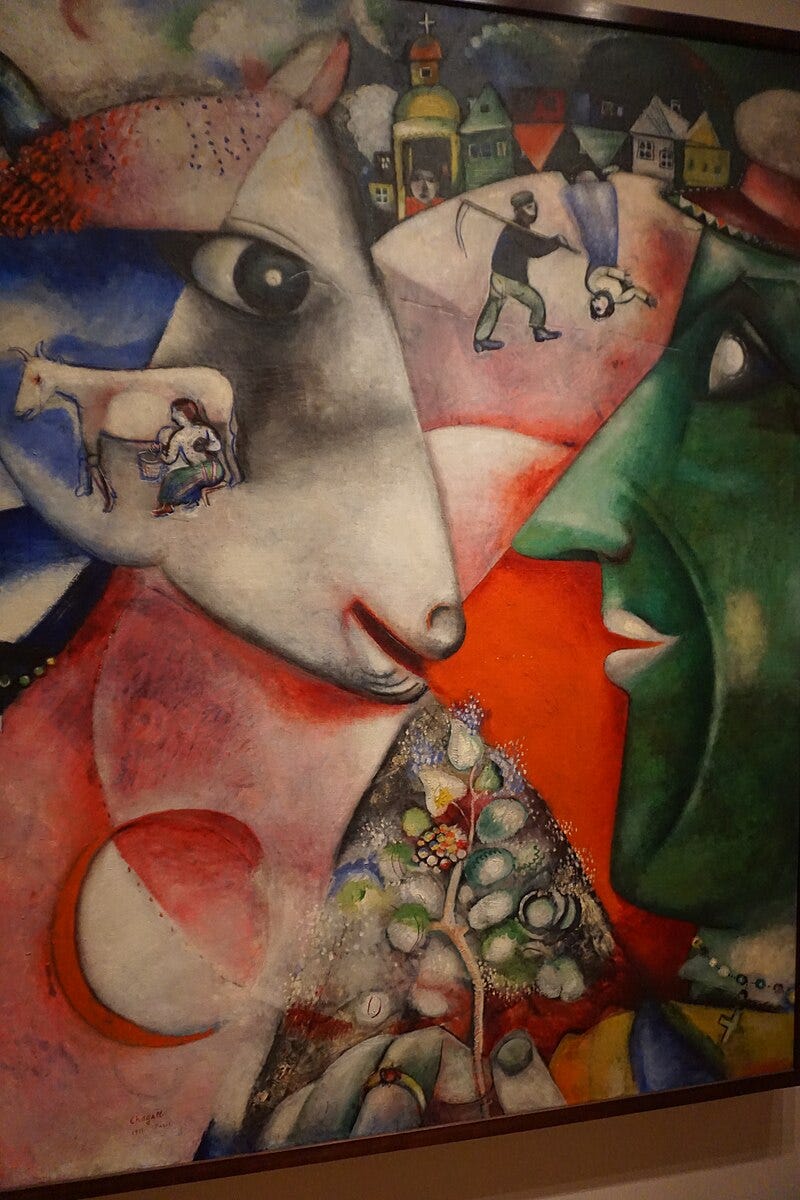
If you’ve been with me for a while, this one may look familiar. I shared the first version last summer. It pulled me where it had to go then, but stories change along with the teller. This time it led me somewhere different. Let’s take a walk….

Sometimes your life ends while you go through all the motions of living. After my mother died, I still chopped garlic, met magazine deadlines, complained to my son about blasting U2 till my ears hurt, as she had once complained to me about an overdose of Dylan. Yet I kept listening for a call from my mother. Could we come for smoked salmon and Negronis? Had I read the new Alice Munro?
She never mentioned Hasidic Tales of the Holocaust, a yellowed paperback with a Chagall painting on the cover. I came upon it while cleaning out her study. She could write all day in her nightgown when the words flowed and no one was coming to lunch. The book sat within arm’s reach of her IBM Selectric, as if at any minute she might need to anchor a chapter with some remembered line from its pages. Instinct told me it belonged on my bedside table.
Yaffa Eliach, who survived the Holocaust and made her name preserving its history, compiled the book from six years of interviews with other survivors—all Hasidim, the most mystically inclined of ultra-Orthodox Jews. Religious orthodoxies, no matter the faith, have always set me on edge, but storytelling is a high devotion in itself. The Hasidim have cherished the defining power of story since their spiritual movement was born in the 18th century. The stories in Eliach’s book are those the tellers pulled from the ashes of everything they prized except their tradition of ardent and generous-hearted worship.
The first death I grieved was my mother’s. She died in her own warm bed while the man she loved sang to her in Yiddish. The people I met in Hasidic Tales had seen entire families murdered. If starvation and exhaustion didn’t take them, they too could be killed any day. Joan Didion said, “We tell ourselves stories in order to live.” The real experts in living are those who return from the very brink of death, bearing stories.
Some people carry good luck charms in their pocket. I carry the first Hasidic tale in my memory.
Thousands of starving prisoners have just been ordered to leave their barracks and report to an open field. After a frenzied stampede to the field, they confront two enormous pits and a guard who bellows the order: Jump one of the pits to safety, or be shot. The S.S. laugh, the emaciated prisoners cower. A rested and well-nourished athlete would be hard-pressed to make the leap.
A man of no faith turns to his friend, the Grand Rabbi of Bluzhov. Why bother to attempt the impossible? All they will achieve is a moment’s amusement for their captors. They might as well climb into a pit and wait for the end.
Exactly what I’d say in their situation. But the rabbi won’t hear of giving up. They must obey the will of God.
The two stand on the edge of a pit as bodies plummet amid the gunfire. They close their eyes, join hands and jump, ready to die together. Lo and behold, they land on the other side. The freethinker, weeping with gratitude, exclaims that God must exist after all. He asks the rabbi, “How did you do it?”
The rabbi answers, “I was holding on to my ancestral merit. I was holding on to the coattails of my father and my grandfather and great-grandfather, of blessed memory…. Tell me, my friend, how did you reach the other side of the pit?”
The friend says, “I was holding on to you.”
The last time life as I had known it disappeared, I didn’t see the end coming. I thought Casey was just growing old. He shuffled on the morning walk, hung his head instead of leaping at squirrels. Lifting his leg to spray the grass, he squeezed out a mere drop or two. Casey had always been lavish with his pee—a gusher to launch the stroll, an encore for every pockmarked wall and patch of clover. He made us lollygag instead of striding, yet I’d come to love his joy in fusing with the day.
I googled “canine UTI.” Yes, that sounded right. All he needed was a week or so of antibiotics wrapped in orange cheddar cheese I would smush till warm between my fingers. The taste of my skin seemed to elevate the treat.
Casey had terminal bladder cancer. Our vet broke the news two years ago this week. On December 23, with Casey’s good days dwindling, we bundled him into the car to kick up fresh snow at his favorite park. If anything could cheer him, it had to be snow. When he sat on the frozen path and shivered, we knew we had reached the end.
No more warm body coiled between us on the TV couch—me stroking his ears while Paul scratched his rump. No more road trips with Casey snoozing on the back seat, so happy to have us to himself that we held onto happiness through wrong turns and traffic jams. The end of yogurt tubs licked till pristine and the kitchen floor scrubbed in Casey’s fashion (every breadcrumb and cheese fleck gone, the parsley sprigs left to us).
I never grieved a human as I did an old mutt with a gray muzzle and a torn right ear. His absence pulled the silken thread that used to join one hour to the next. My days hung in tatters. Could this be excessive? Unseemly, even? No one was out to murder me and all my kind.
I remembered the credo of Dr. Edith Eva Eger, clinical psychologist and Auschwitz survivor, in her memoir The Choice: “There’s nothing that makes my pain better or worse than yours, no graph on which we can plot the relative importance of one sorrow versus another. People say to me, ‘Things in my life are pretty hard right now, but I have no right to complain—it’s not Auschwitz.’… I don’t want you to hear my story and say, ‘My own suffering is less significant.’ I want you to hear my story and say, ‘If she can do it, then so can I!’”
A story, when you’re reeling, is a steadying hand at the edge of a pit. People often slap a label on the story you need: “triumph of the human spirit.” One brave, tenacious human is seen as the font of inspiration. I can’t knock courage, but what about care? In the story of the rabbi and his friend, humans lift each other to safety in a dance of exquisite symmetry. The rabbi’s faith in God and tradition empowers the atheist to jump, yet it’s the hand of the atheist that leaves the rabbi in awe. The leader knows he has been led.
As my mother said when she learned that she was dying of a brain tumor and not slipping into Alzheimer’s, the scourge of her family, “How interesting.”
I had just dipped my spoon into a bowl of burnt marshmallow ice cream when grief tiptoed up from behind and walloped me. Casey had been gone for a month, yet it seemed just hours ago that we left the vet’s with his empty collar. My sobs penetrated the closed door of my husband’s office, pulling him from a Zoom meeting. “What happened? What’s wrong?”
The group wondered what was up, so he told them. As it happened, two people saw a little of themselves in us. In condolence notes that arrived the next day, they disclosed their own sorrows: a spouse with Alzheimer’s, the endless exhaustion of caregiving. Paul had known them as names on an email list. That day they revealed their stricken hearts. It hadn’t occurred to me that my grief for Casey had anything in common with theirs. Yet all three of us know how it feels to go through the motions of living—call the plumber, fill the scrip, change the sheets—when sometimes all you can do is weep into your hands.
Grief breaks but holds the power to bind. I’ve seen this over and over, meeting you here on Sunday morning. “I needed that,” someone says, as if she’s holding on to me. Then someone else is moved to share a story. Stories fall like ripe apples into open hands. Lives as we have known them end in stories, and meanwhile the next life begins.
Let’s imagine it together, that beginning. Here’s a window, open to the breeze. Over there, a dog napping on a sun-warmed Persian carpet (or a cat if you prefer). Two chairs that hold us as one gentle hand holds another. Why don’t you pull yours a little closer? Any minute, our stories will be dancing.
Dancing partner of mine, perhaps you’ve seen this coming. I’m holding on to you.
Let’s talk, friends. Whose hand have you held when the going got rough? Have you ever learned, years after the fact, that someone was holding on to you when it mattered most?
I’ve been preparing all my life to host you here, from the first stories I told to grade-school classmates through the monthly column I wrote while editing a women’s magazine. In blog posts and keynote speeches, I’ve shared my formative moments in the hope of illuminating yours. I’ve never found a more congenial story space than this one, and I throw the doors open for the joy. Do browse and share—I wouldn’t have it any other way.
A tiny percentage of my readers have chosen a paid subscription just because they value my work. If now’s the time for you to join them, you will make my day. You don’t have to step up but you do. How amazing is that?
Are you ready to get serious about a personal essay of your own? I offer one-on-one coaching for writers at all levels with a discount for paying subscribers. I coach the way I write—from the heart, to the point. Let’s book a free 20-minute consultation to see if we’re a fit. Details here.
Wow. I don't read this before (your prior version), I feel like I would have remembered it, it's so beautiful. There are so many gems to remark on. You are so dear, my friend. xo
"The rabbi answers, “I was holding on to my ancestral merit. I was holding on to the coattails of my father and my grandfather and great-grandfather, of blessed memory…. Tell me, my friend, how did you reach the other side of the pit?”
The friend says, “I was holding on to you.”
I'd like to go over this essay line by line with you. It's gorgeous. xo
My mother too, at the end or close to it, asked me what was happening. “I see your father very near.” He who was decades gone. She could feel herself in two realms but had no words for it. I could feel it too, some of what she felt, sitting next to her lying on the same sofa my father had lain upon with unrecoverable cancer, as her own mother had lain upon, no longer able to take care of her needs. There was a peace between the worlds that held an awakening to perceptions new to me. “You are dying,” I said. “How interesting,” she said.