

Dear Kiddo
A little love, hope and lightness for my teenage self

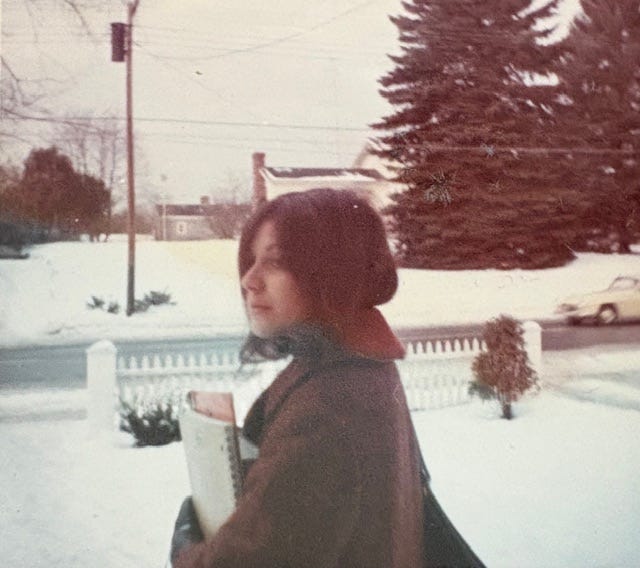
Dear Kiddo, sometimes you wait a lifetime for a moment. I’ve never called anyone “kiddo” before, but it’s never too late to lighten up. I’ve been saving this word just for you, never mind your scorn for all things folksy. You’re probably rolling your eyes, but bear with me. You don’t have to fight me; I’m not your mother. It’s the opposite, almost. I found my way out of you, the girl with the vodka hidden in her desk and the Mexican beads slung over the mirror. There’s not much about you I don’t know.
If we passed on the street, you wouldn’t notice me. You don’t trust anyone over 30; I’m way more than twice that age. I wear the clunky lace-up shoes that keep me walking; you won’t be seen in anything but leather boots that bare a lot of leg beneath the hem of your velveteen minidress.
I’m with you, walking home from school at nightfall, your arms full of books and binders. You’ve stayed late to rehearse The Miracle Worker. Wind bites your throat and whips your hair (you have no use for hats). Your boots—made for show, not walking on a winter evening in New Hampshire—slip and slide on the ice. You don’t expect to be anything but alone, queen of that underlit road where dark enfolds you like a mantle. You forget to be lonely when there’s no one around to expose all the ways you don’t belong.
Light glimmers in the windows of a few distant houses. If you screamed, would anyone hear? The thought doesn’t enter your mind. You’re playing Helen Keller. Soon you’ll blow this town and find your tribe. You’ll be chosen by the one with the Rimbaud cowlicks, the Belmondo grin and the warm hand cupping your tush through the back pocket of your jeans as you saunter together in your glory.
And tonight there’s apple pie for dessert. No one bakes a pie like your mother.

The books I never lend always sit within reach of my desk. Women Writers at Work had a close encounter with a glass of water and falls open to Maya Angelou, whose conversation with The Paris Review I’ve read so many times, it’s coming loose from the binding. If she never said anything else, she has my heart for saying this:
Most people don’t grow up. It’s too damn difficult. What happens is most people get older. That’s the truth of it. They honor their credit cards, they find parking spaces, they marry, they have the nerve to have children, but they don’t grow up…. [T]o grow up costs the earth, the earth. It means you take responsibility for the time you take up, for the space you occupy. It’s serious business. And you find out what it costs to love and to lose, to dare and to fail. And maybe even more, to succeed.
You’ll get there, kiddo. I’m proof, waiting for you down the road. Not that you’d want my life. Instead of a loft in the Village, pitted floorboards stained with candle wax, a condo in Toronto with a brand-new standalone freezer. Instead of a novel to make my name, a Substack that makes me a circle of friends, most of whom I’ll never meet face to face. The louche lover with the Rimbaud cowlicks turned out to be a husband of little hair and long experience—55 years and counting—with my irritable side, a hand-me-down from you. Sometimes I reread your journals. They remind me how far I’ve come since I was trapped inside you, a champion kvetch.
Every page bristles with judgment and complaint. You save the worst for your friends, whose kindness goes unremarked while their doofus blunders—misspent lust, maudlin laments—are entered in the record of shame. You wonder why no man has chosen you for his own. Take it from one who learned the hard way: Until you start loving, you’ll be hard to love.
Remember David Copperfield? You read it more than once, growing up. You ached for young David—orphaned, then abused by the iron-hearted Murdstones. Exiled from the only home he’s known to fend for himself as a child laborer. Enthralled by David’s suffering, you missed the point: Love guides him out. It appears as a crusty great-aunt with a grudge against males, a manchild possessed by an unattainable dream, a ne-er-do-naught driven by unquenchable hope—an entire teeming cast of eccentrics whose gift for loyalty outweighs their foibles and delusions. You skimmed all that.
Dickens captured the cost of growing up. You may trust a false friend or chase a beautiful illusion. You may take years to see where malevolence is lurking. You’re only human. One true friendship and instructive mistake at a time, you arrive where you belong. For David, it’s a writing career and marriage to the soulmate he passed by in his callow youth.
Kiddo, you think you have it rough. Classmates who haven’t read Lawrence Ferlinghetti or heard of Ingmar Bergman. Your father’s drinking, never discussed except as the “bad mood” that’s supposed to excuse bad behavior. Truth is, no one gets out of adolescence unscathed. Decades after I blew your town, a motley band of schoolmates connected online and shared secrets from the past. The alcoholic parents could have filled a chorus line. And they were just the start. We’re talking kids beaten at home, scorned by teachers for being foster children. Told over and over to forget about college—most dismayingly by the guidance counselor. Forty-five years on, I wanted that dream killer fired. At least two of my classmates showed him up: They earned doctorates.
There’s a beach where you go with a couple of girlfriends. All pebbles and crags, no boardwalk or cotton candy. You three take your guitars to the highest rock, where you sing and strum to the gulls. Barbara’s crush object has fallen for a teeny bopper; you stick it to them both in a satirical ditty that no one will hear but you—three stooges, three witches, three misfit graces too fine for high school. You crack each other up. So why does nobody laugh in your journal?
Here you go again, kiddo, scribbling another entry. You’ve set the mood with Blonde on Blonde and a cranberry screwdriver. What a sharp observer you are, how attuned to the offhand remarks that reveal the frailties of others. This talent is your spear and your shield. To write your joys—you do have them, on the beach with your friends—would be to feel them so deeply you couldn’t bear the thought of losing them.
A friend has told you, “I don’t know what I’d do if you died.” It’s right there in your journal, tossed in without reflection. You envy this girl her heartbreaking beauty, her allure to a boy you like (not that you’d admit it, even in your journal). You don’t dare need her back. In a moment of pique, you call her “a trivial person.” Even so, she spends four days making an ornament for your bedroom window. You throw it away.
You never speak of suicide. In 1967 no one does. Now it strikes me that your beautiful friend, who knows your anguish, may fear for your life. She doesn’t know the reason you plan to stick around. You’re still waiting for your life to begin. The friends you have now seem a mere warmup act for the main event. You sigh over Ferlinghetti’s line “I am perpetually awaiting/ a rebirth of wonder.”
Your depression followed me into adulthood. The first one to name it was the therapist who sat me down and informed me that life as I had known it was due for renovation. At 36 I learned that wonder doesn’t knock on anyone’s door. You have to go in search of it. You have to like it small—dew beading a leaf, wind turning the pages of an abandoned book. You’re wise to write it down, and take a photo if you can, before it’s buried in the onslaught of dire news for the world.
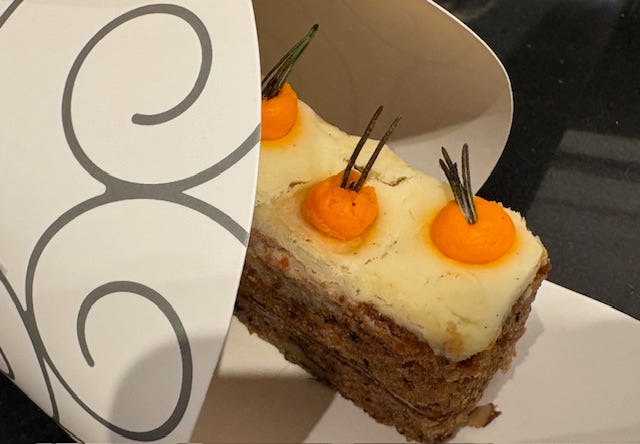
Yesterday my husband brought me a slice of carrot cake, prettily boxed and decorated with icing carrot coins. It had spent five days in a crowded corner of his office, where he placed it in a moment of distraction and went on to other things. He knew his gift would land in the recycling bin, but he wanted to make me happy. You could say I waited a lifetime for a box of stale cake and fresh love.
Kiddo, I never wrote that novel you imagined. Perhaps I never will. The names people make can be forgotten; it’s their words and deeds that endure, while there’s anyone around to remember. A while ago I searched online for that beautiful girl whose gift you threw away. I found her on Facebook, sent her a note. I was thinking of you and the love she offered when you felt alone in the world. She didn’t answer.
Yours forever,
Rona
What would you like to tell your young self? The clueless kid might tune you out, but we’re all listening here. I’ll do my best to answer every tip, plea and confession.
Friendship is one of those under-explored topics I can’t resist for long. I’m particularly proud of “How to Be a Friend,” tied for the second-most-popular post I’ve yet posted.
Everything you find here is free to enjoy and share. If it makes you happy and you’re feeling generous, paid subscriptions make my day. There’s one perk: a discount on my personal coaching for writers at any level. Memoir and personal essay only; free, 20-minute meeting to see if we’re a fit. Details here.
And now for something completely different….
MY NEXT ACT IS STORY SLAMMER. COME TO THE SHOW!
Join me April 18 for the next edition of Wham! Bam! Thank You! Slam! I’ve teamed up with nine other truth tellers and mischief makers who can’t wait to rip the lid off this month’s theme, Death and Taxes. We’ve got the voices, the sizzle and the spirit. All we need is you. Learn more and get your ticket here.

Oh, my, Rona. I think this one is in my top 2 or 3 of your essays. Even though our details are different, I put myself in your place. I talk to my former self, my inner teen, (and child), on a regular basis. The Maya Angelou quote is one of my favorite, she was spot on. I know that from my own experience, my evolution. My teen self is still very present in all that makes me, me. She's my fighter, my activist. She's my truth teller, and my moral compass, often. And sometimes my little self (the 5-6 year-old) helps. She has a strong take on justice. Those kid parts of me help keep older me honest. AND thank you for posting about the slam. I'll definitely be there! xo
This is gorgeous, Rona. I was teary throughout. I can only imagine how this younger version of you would feel, to be so fully seen with so much compassion and wisdom. I loved everything in this piece, and the ending is just perfect. I'll come back to reread this one, for sure.